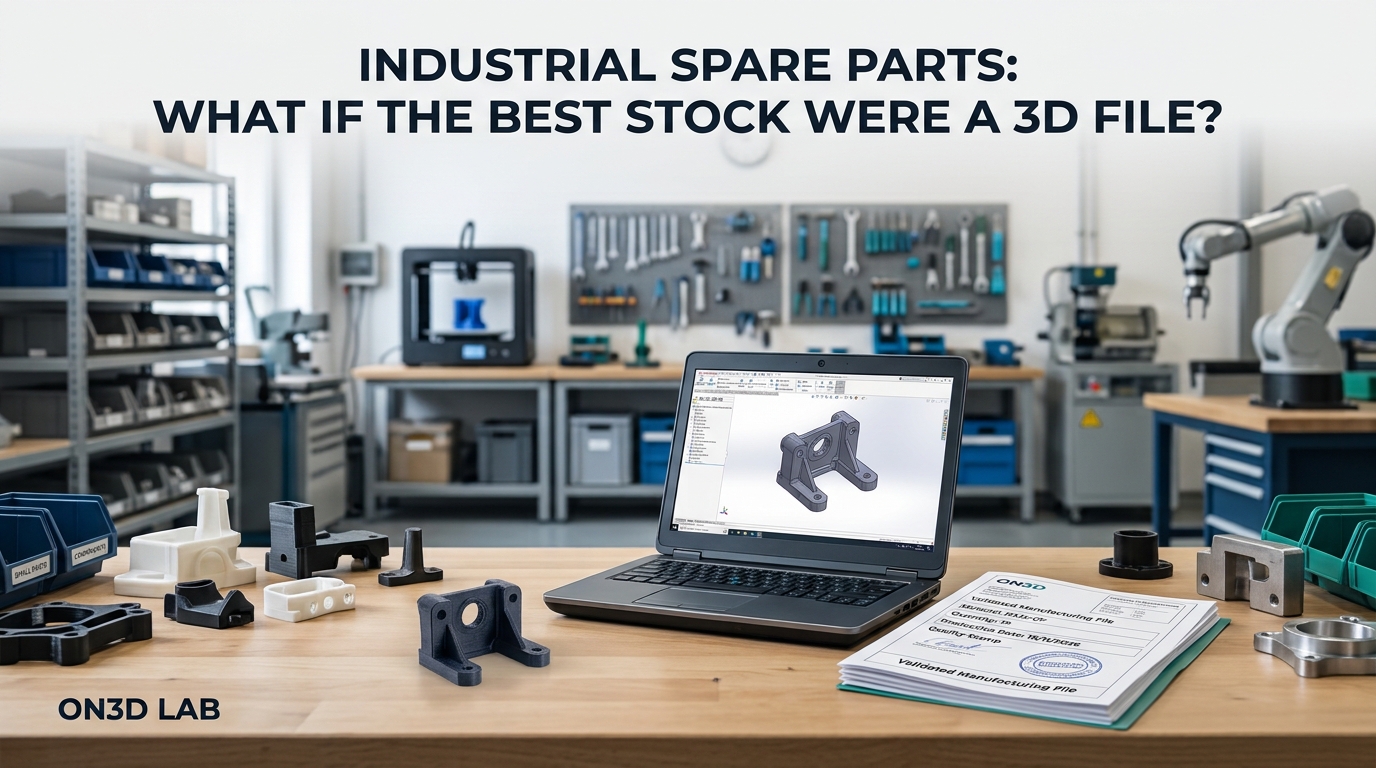
A maintenance storeroom does not necessarily hold every part a factory will need. For certain plastic parts, the solution may be to retain a validated manufacturing dossier and produce the part only when it is needed.
In a production workshop in Oran, a small plastic part can have disproportionate consequences: a broken cable guide, an unavailable cover or a specific spacer can sometimes be enough to complicate the return of equipment to service.
When a part is old or rarely requested, its availability from the supplier can become just as important as its price.
On-demand additive manufacturing, combined with a digital inventory of qualified parts, offers an approach that complements the traditional storeroom.
The idea is not to replace everything with 3D printing, but to select the right parts, prepare their manufacture and avoid repeating the engineering study whenever a need arises.
1. A digital inventory is more than a folder of STL files
A physical inventory contains parts ready to be fitted.
A digital inventory retains the information needed to reproduce certain parts under controlled conditions: CAD model, revision, material, relevant manufacturing parameters, inspections and operating conditions.
The distinction matters.
An STL file essentially describes triangulated geometry. On its own, it provides no information about the original material, functional tolerances, loads or safe use.
A 3D model therefore becomes a true inventory item only when it is accompanied by a technical dossier suited to its function.
In practice, the strongest solution is often hybrid: keep standard, urgent or critical parts physically in stock, while preparing digital manufacturing for a selection of specific components that are rarely used or have become difficult to obtain.
2. What industry is already doing: two documented examples
Würth: more than 100 digitised parts
In March 2025, Würth Additive Group launched a first version of its Digital Inventory Services platform.
The platform enabled the management of part data, access rights and validated manufacturing processes, with particular attention to traceability and intellectual property.
In November 2025, its partner IMS reported that more than 100 clips and fasteners had been digitised, qualified and uploaded to the system.
Siemens Mobility describes a virtual warehouse containing more than 2,100 different part references and reports having sold more than 31,000 printed parts to railway industry customers.
This activity covers different processes and materials, with engineering, inspection and, where necessary, certification stages. It is therefore not limited to plastic FDM printing.
These examples illustrate an essential principle: digital data is most valuable when it enables a part to be manufactured again in conformity with an identified use.
However, they provide neither a lead-time guarantee nor a promise of savings that can automatically be applied to an Algerian SME.
3. Not every part is worth digitising
The relevant question is not simply:
“Can this part be printed?”
Instead, ask:
“Is manufacturing it on demand useful, technically acceptable and economically worthwhile?”
A university study appearing in a January 2026 issue, examining spare parts at a large paper mill, estimated that around 1% of the part references analysed had real potential for additive manufacturing within the scope of the study.
The authors also stress the importance of having local suppliers capable of producing the selected components.
Generally unsuitable for a simplified replacement approach
Specific qualification and authorisations
Material is one variable among others.
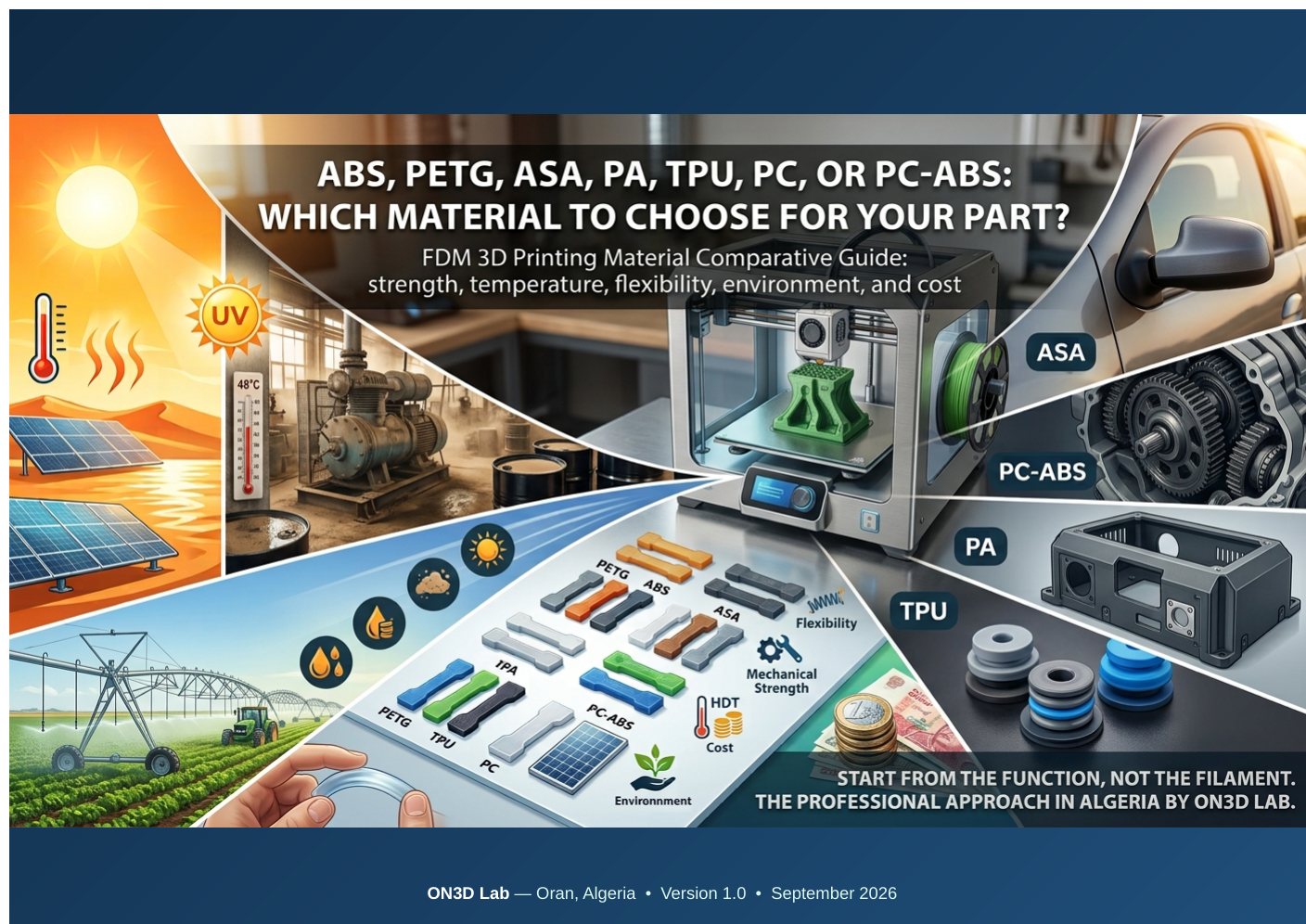
ABS, PETG, ASA, nylon, PC or TPU must be selected according to the available grade, geometry, environment and required testing.
No polymer designation, on its own, guarantees that a part meets its requirements.
4. From a maintenance part to a digital inventory
Creating a reliable digital part reference requires several operations.
Identify the part and understand how it is used. The equipment concerned, important dimensions, loads, known or assumed material and consequences of a possible failure must be documented.
Check reproduction rights. An original part is sometimes still the best option. Reproduction must comply with applicable requirements, intellectual property rights and any contractual restrictions.
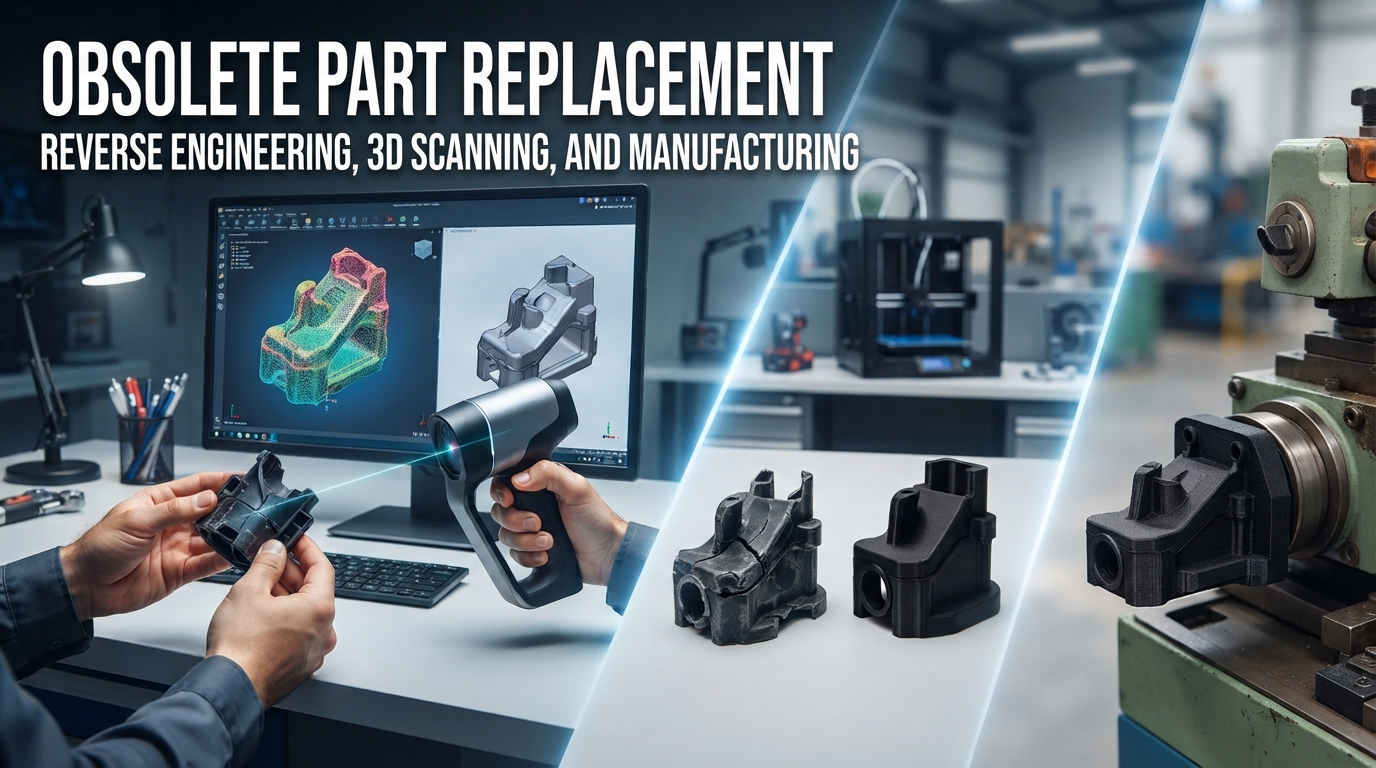
Obtain usable geometry. A technical drawing or CAD file can serve as a starting point. When these are unavailable, dimensional measurement, a 3D scan or geometric reconstruction may be considered.
A scan does not, however, automatically recover the designer’s intent, tolerances or properties of the original material.
Choose the process and material. For certain plastic components, FDM/FFF printing is an attractive option in small quantities.
Mechanical, thermal, chemical and dimensional constraints must be studied before manufacture.
Manufacture and qualify a first sample. The prototype must be inspected against its functional characteristics.
Representative testing may be needed to verify its suitability for the intended use.
Build the reference digital dossier. Once the part has been validated, the files, important parameters and inspection results are archived under an identifiable part reference.
Reproduce the part with verification. When a new request is received, the manufacturer checks the version, material and production conditions before starting manufacture.
This method builds on work already completed without removing the need for inspections.
The ISO/ASTM 52920:2023 standard provides a reference framework for the qualification and quality assurance of industrial additive manufacturing processes. However, following its principles does not automatically certify a part or a workshop. ISO — ISO/ASTM 52920:2023
5. What should a part’s digital dossier contain?
A parts library should do more than make it possible to find a 3D model.
It should provide enough information for the part to be understood and reproduced under controlled conditions.
Information
Purpose
Part reference and equipment concerned
Avoid confusion
Function and criticality level
Define requirements
Native CAD and STEP files, if available
Enable modifications
Manufacturing file and revision
Reproduce the correct version
Material and grade
Document the selected material
Key manufacturing parameters
Improve repeatability
Dimensions and inspection criteria
Verify conformity
Testing and validation history
Ensure traceability
Access rights and backups
Protect data
This organisation can begin with a structured register and properly versioned folders.
A more advanced platform can later automate searches, manufacturing requests and maintenance intervention histories.
6. How can the economic value of a digital inventory be assessed?
A locally printed part may cost more per unit than a moulded part produced in a large series.
That does not necessarily make it a poor solution.
The economic analysis must compare both supply methods across their full costs.
For a traditional order, consider the part price, transport, minimum order quantities, storage and delivery lead time.
For additive manufacturing, consider modelling, the prototype, testing, material, manufacture, inspection and any replacements.
When machine availability is at stake, the company must also examine the economic consequences of waiting.
The right indicator is the time between identifying the need and having a technically accepted part available, rather than printing time alone.
The economic case must be calculated using real data specific to the company.
7. A practical example in an Algerian company
Consider an illustrative case, which is not presented as work carried out by ON3D Lab.
A packaging company owns an old production machine.
A small plastic bracket used to hold a sensor is damaged. The original part is difficult to obtain quickly.
The maintenance department provides the existing part, available dimensions and information about its use.
After verifying that it has no safety function and that the necessary rights are in place, a service provider studies its geometry.
A first version is modelled and then manufactured in a material suited to the observed conditions.
The technical department checks the fit, dimensions and actual use.
If the results are satisfactory, the model is archived with its part reference, material, manufacturing conditions and inspection results.
When another part is needed, the company can start from this dossier rather than repeating the entire engineering study.
This method does not remove the need for inspections. A change in geometry, material or operating conditions may require renewed validation.
For manufacturers in western Algeria, this approach is particularly relevant when it combines the maintenance department’s knowledge, an engineering office’s skills and a local additive manufacturing workshop.
8. The limits of digital inventories
A digital inventory is not a universal solution.
It depends on the availability of materials, manufacturing equipment, skilled people and technical data.
Files must also be protected against loss, unauthorised changes and inappropriate access.
A printable part is not necessarily a suitable substitute for an original part.
Components involving safety, heavy loads, pressure, electricity or regulated environments require specific assessments.
Chemical resistance, thermal performance, wear and ageing cannot be established through a simple fit test.
A credible approach is therefore to start with a few plastic parts of low criticality, using reproducible inspections and a documented comparison of costs and lead times.
Conclusion: preserve the know-how as well as the part
A digital inventory is not a library of STL files to print indiscriminately.
It is a technical memory of selected parts, linking their function, design, manufacture and validation.
For an industrial SME in Algeria, the benefit is practical: prepare the reproduction of certain plastic parts, reduce supply uncertainties and make better use of the knowledge gained from maintenance interventions.
Physical stock remains essential when urgency, safety or production requirements justify it.
At ON3D Lab in Oran, we support the engineering, modelling and manufacture of custom technical plastic parts.
To examine the feasibility of a spare part or begin building a library of part references, a drawing, a photograph with useful dimensions or an existing part can provide an initial basis for discussion.
An unavailable plastic part can sometimes be rebuilt from an existing sample. Follow the steps from scanning to CAD, manufacturing and inspection, and understand their limits.
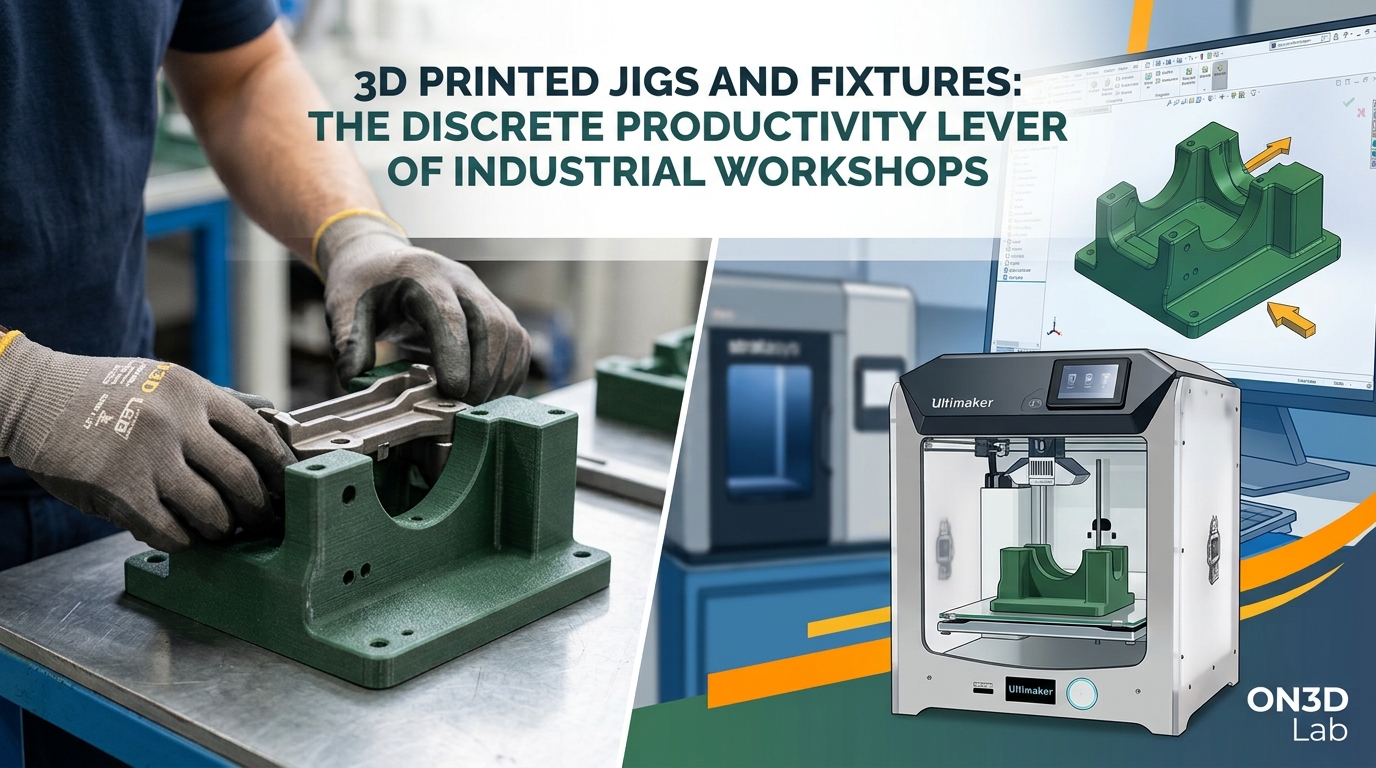
A well-designed plastic tool can make positioning, assembly and inspection easier. Explore applications, limitations and a practical method for assessing workshop benefits.