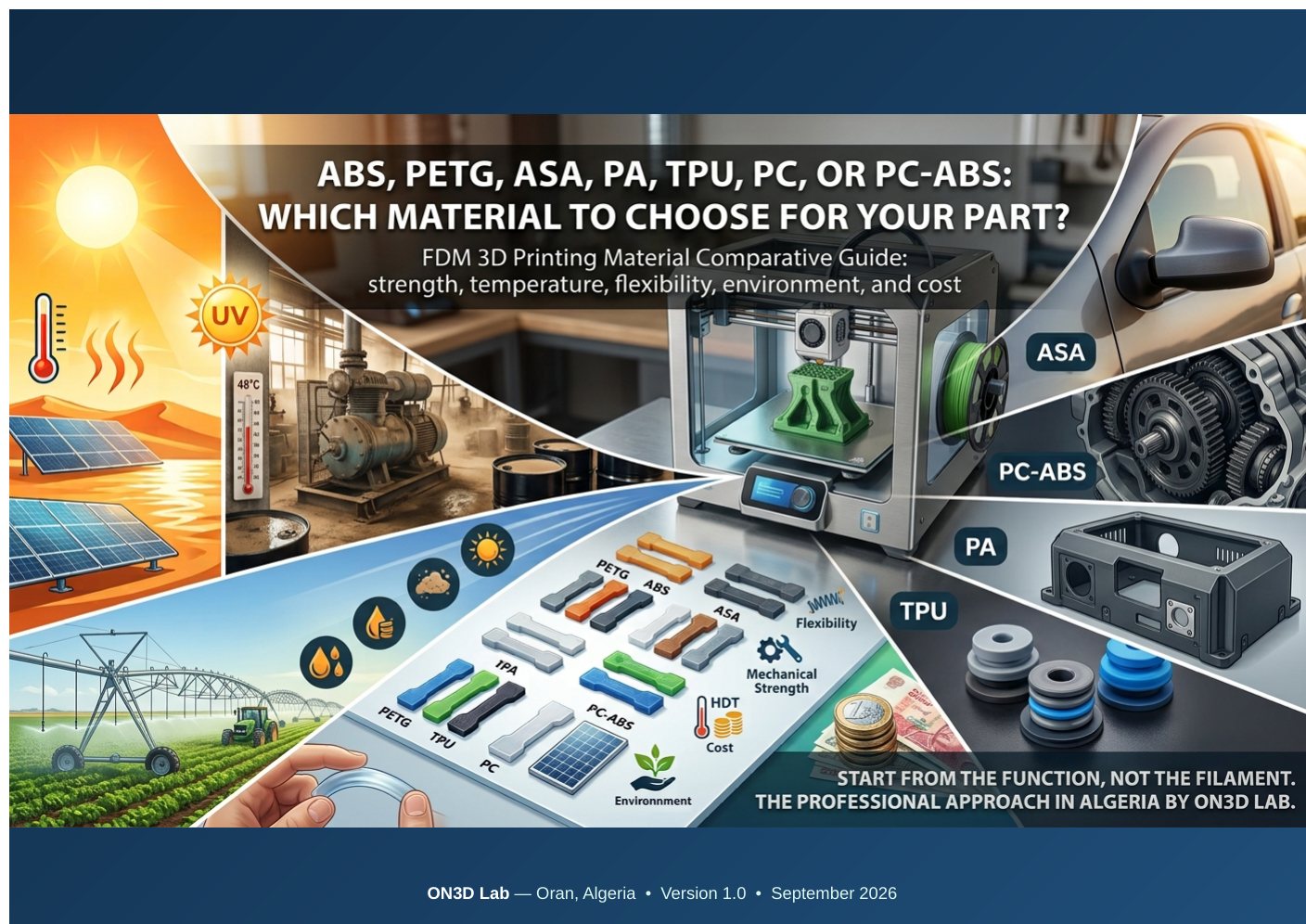
ABS, PETG, ASA, PA, TPU, PC or PC-ABS: Which material should you choose for your part?
Compare FDM 3D printing materials: PETG, ABS, ASA, PA/Nylon, TPU, PC and PC-ABS. Strength, heat, flexibility, wear, cost and applications in Algeria.
Contents
Comparing FDM 3D printing materials: strength, temperature, flexibility, environment and costMaterial comparison tableWhat HDT means1. PETG: a versatile choice for functional partsWhen should you choose PETG?2. ABS: the established engineering plastic3. ASA: ABS-like performance for outdoor useWhy ASA matters in Algeria4. PA / Nylon: for parts that really workThe critical issue: moisture5. TPU: when deformation is the functionWhy is a single HDT figure unhelpful for TPU?6. PC: when strength and temperature come firstWhy not use PC for every part?7. PC-ABS: a balance between ABS and PCTemperature: read the figures correctlyTg: glass transition temperatureVicatHDT: heat deflection temperatureIn Algeria, ambient air temperature is not enoughMaterial is not the whole storyWhich material should you choose? A quick methodVersatile, economical functional partIndoor mechanical part needing heat and impact resistanceOutdoor part exposed to UV and sunlightFriction, wear or repeated motionFlexibility, vibration or dampingStiffness, mechanical strength and high temperatureImpact and heat with a balanced industrial solutionWhat about cost?Conclusion: start with the function, not the filamentTechnical referencesPolymaker — ChinaeSUN — ChinaAdditional sourcesMethodological noteAbout ON3D LabComparing FDM 3D printing materials: strength, temperature, flexibility, environment and cost
Choosing a 3D printing material is not simply a matter of finding “the strongest plastic.”
A sensor bracket in a factory, a gear, a housing inside a vehicle, an outdoor part and a vibration-absorbing stop all face different demands. Select the material according to the part's actual function and operating environment.
This matters particularly in Algeria. Parts may face high temperatures, sunlight, dust, oils and vibration, or operate close to a motor, compressor or hot industrial equipment.
Maintenance adds another consideration: availability of the original part. When a spare part takes weeks to arrive or is no longer made, 3D printing can quickly provide a functional alternative. That alternative still needs the right polymer.
Technical FDM parts commonly use PETG, ABS, ASA, PA/Nylon, TPU, polycarbonate (PC) and PC-ABS.
Material comparison table
Important: The figures below are indicative ranges drawn from documented technical data sheets for commercial grades. They do not apply universally to every filament sold under the same material name.
| Property | PETG | ABS | ASA | PA / Nylon | TPU 95A | PC | PC-ABS |
|---|---|---|---|---|---|---|---|
| Ease of printing | ★★★★☆ | ★★★☆☆ | ★★★☆☆ | ★★☆☆☆ | ★★★☆☆ | ★★☆☆☆ | ★★☆☆☆ |
| Stiffness | Good | Good | Good to high | Good; grade-dependent | Very low | Very high | Very high |
| Mechanical strength | Good | Good to very good | Good to very good | Very good | Good tensile strength, but flexible | Excellent | Very good to excellent |
| Impact resistance | Good | Very good | Good to very good | Very good | Excellent | Excellent | Excellent |
| Wear / friction | Moderate | Moderate | Moderate | Excellent | Very good | Good | Good |
| Indicative HDT | ≈ 64–78 °C | ≈ 98–100 °C; up to ≈ 104 °C for some high-temperature grades | ≈ 100–103 °C | ≈ 70–111 °C for some unfilled PA grades; up to ≈ 155 °C for certain carbon-fibre-reinforced grades | Highly grade-dependent; HDT is less meaningful for an elastomer | ≈ 107–111 °C | ≈ 106–112 °C |
| UV resistance | Moderate | Poor | Excellent | Poor to moderate | Formulation-dependent | Poor to moderate | Poor to moderate |
| Moisture resistance | Good | Good | Good | Poor: highly hygroscopic | Moderate | Moderate | Moderate |
| Outdoor use | Possible | Generally unsuitable long term | Excellent | Choose a suitable grade | Choose a UV-rated grade | Choose a stabilised grade | Choose a stabilised grade |
| Oils / greases | Good for some grades | Good for some grades | Good | Good | Formulation-dependent | Good for some grades | Good for some grades |
| Flexibility | Low | Low | Low | Low to moderate | Very high | Very low | Low |
| Warping | Low | High | Moderate to high | Moderate to high | Very low | High | High |
| Enclosed printer | Not essential | Recommended | Recommended | Recommended | Generally unnecessary | Strongly recommended | Strongly recommended |
| Drying | Recommended when damp | Helpful | Recommended | Essential | Recommended | Strongly recommended | Strongly recommended |
| Indicative nozzle temperature | ≈ 230–260 °C | ≈ 240–265 °C | ≈ 230–260 °C | ≈ 250–300 °C depending on grade | ≈ 210–250 °C | ≈ 260–290 °C | ≈ 250–270 °C |
| Indicative bed temperature | ≈ 70–90 °C | ≈ 90–100 °C | ≈ 75–95 °C | ≈ 50–90 °C depending on grade | ≈ 25–60 °C | ≈ 90–110 °C | ≈ 90–105 °C |
| Relative cost | €€ | €€ | €€–€€€ | €€€ | €€€ | €€€€ | €€€–€€€€ |
| Typical applications | Brackets, clamps, enclosures, prototypes | Housings, mechanical brackets | Outdoor parts, automotive parts, enclosures | Gears, guides, sliding parts | Stops, protection, damping | Demanding mechanical and thermal parts | Technical housings, impact plus heat |
What HDT means
HDT, or heat deflection temperature, measures deflection under a specified load. It is not a guaranteed maximum operating temperature.
Two grades of one material can differ substantially. Formulation, additives, moisture, print orientation, possible annealing and the test method all influence the result.
1. PETG: a versatile choice for functional parts
PETG (polyethylene terephthalate glycol-modified) is often a sound starting point for a functional part.
It combines good mechanical strength, good layer adhesion, little warping and relatively straightforward printing.
It suits brackets, clamps, enclosures, guards, guides, functional prototypes and moderately loaded mechanical parts.
Depending on the commercial grade, PETG's HDT is generally about 64 to 78 °C. This range shows why a material-family name alone cannot characterise a finished part.
When should you choose PETG?
Choose PETG when a part needs to work reliably without facing very high heat, substantial friction or severe mechanical loads.
In an Algerian industrial workshop, examples include a sensor bracket, connector guard, clamp or static guide.
For a part inside a sun-heated vehicle, near an engine or in a hot machine, assess ABS, ASA, PC-ABS or PC instead.
Key point: PETG offers versatility, easier printing and controlled cost.
2. ABS: the established engineering plastic
ABS (acrylonitrile butadiene styrene) has long been used in industry and automotive applications.
It balances stiffness, toughness, impact resistance, thermal performance and cost.
Technical commercial grades commonly have an HDT close to 98 to 100 °C; some high-temperature formulations exceed 100 °C slightly.
For example, eSUN reports an HDT of about 104.4 °C for its ABS-HT, with XY tensile strength around 46 MPa. The manufacturer also recommends an enclosed printer for this grade.
This illustrates a crucial distinction: standard ABS and high-temperature ABS are not identical products.
ABS is more demanding to print than PETG because it shrinks as it cools. A long or bulky part may warp if the printing environment is not sufficiently stable.
Key point: ABS balances mechanical performance, impact and heat, especially indoors.
3. ASA: ABS-like performance for outdoor use
ASA (acrylonitrile styrene acrylate) is often compared with ABS, but it has a decisive advantage: resistance to UV and weathering.
It is therefore well suited to parts intended to remain outdoors for a long time.
Some commercial ASA grades have an HDT around 100 to 103 °C while retaining good resistance to outdoor ageing.
For instance, eSUN describes ASA+ as better suited than ABS to UV exposure and harsh weather, with better retention of colour and mechanical properties after prolonged sunlight exposure.
Why ASA matters in Algeria
For a permanently installed outdoor part, UV resistance can matter as much as mechanical strength.
A sensor enclosure, roof-mounted bracket, agricultural equipment component, exterior automotive accessory or machine guard may be exposed to sun every day for years.
In these cases, ASA is generally preferable to ABS.
An enclosed printer remains useful to limit shrinkage and warping.
Key point: ASA combines heat, UV and outdoor durability.
4. PA / Nylon: for parts that really work
“Nylon,” or PA (polyamide), refers to a whole family: PA6, PA66, PA11, PA12, PA6/66, carbon-fibre-reinforced PA, glass-fibre-reinforced PA and more.
No single figure describes all nylons.
Their main value generally lies in a combination of toughness, wear resistance, low friction and fatigue resistance.
PA is useful for:
- gears and pinions;
- guides and sliding parts;
- bushings and hinges;
- industrial replacement parts exposed to repeated motion.
For some documented unfilled PA grades, HDT can range from about 70 to 111 °C, depending on the test load.
Fibre reinforcement can push this much higher. For example, eSUN reports an HDT of about 155 °C at 0.45 MPa for ePA-CF, a carbon-fibre-reinforced PA6/66.
That is why “Nylon: 100 °C” is misleading. The exact grade changes everything.
The critical issue: moisture
Polyamide is hygroscopic: it absorbs moisture from the air. This can seriously degrade:
- extrusion quality and surface finish;
- dimensional accuracy and layer adhesion;
- mechanical properties.
Drying is therefore part of the process, not a minor detail. For industrial PA parts, manage filament moisture both before and during printing.
Key point: PA is a strong candidate for friction, wear, fatigue and demanding mechanical parts.
5. TPU: when deformation is the function
TPU (thermoplastic polyurethane) should not be judged in the same way as rigid plastics. Its ability to deform is the very reason to use it.
TPU 95A can be used for:
- stops, guards and cable grommets;
- non-slip surfaces and wheels;
- damping and vibration-absorbing parts.
Commercial TPU 95A grades may stretch by several hundred percent before breaking. For example, Polymaker PolyFlex TPU95 has a Shore 95A hardness and, under certain test conditions, elongation at break above 500%.
Why is a single HDT figure unhelpful for TPU?
For an elastomer, heat deflection is less intuitive: the material is designed to flex already.
It is more useful to examine the exact grade, Shore hardness, chemical resistance, behaviour at temperature, compression and wear.
Do not assume any TPU is automatically compatible with diesel, petrol or hydraulic oil. Check compatibility with the exact fluid and material grade.
Key point: TPU is for flexibility, damping, vibration and impact absorption.
6. PC: when strength and temperature come first
Polycarbonate (PC) is among the highest-performing engineering plastics commonly available for FDM.
It combines stiffness, mechanical strength, toughness, impact resistance and thermal resistance.
For example, Polymaker PolyLite PC reports XY tensile strength near 69 MPa, glass transition temperature around 113 °C, Vicat softening temperature near 120 °C and HDT around 107 to 111 °C, depending on the applied load.
These properties suit structural brackets, tooling, heat-exposed housings, mechanical parts and environments where PETG or ABS reaches its limits.
Why not use PC for every part?
Performance comes with manufacturing demands. PC generally requires a high nozzle temperature, a very hot bed, properly dried filament, a stable enclosure and good warping control.
For a simple bracket at room temperature, PC may bring no useful benefit if PETG already meets the specification.
Key point: PC combines high stiffness, mechanical strength and heat resistance.
7. PC-ABS: a balance between ABS and PC
PC-ABS blends polycarbonate and ABS. It aims to combine some of PC's thermal performance and toughness with ABS's processing and finish characteristics.
For Polymaker PC-ABS, the HDT is approximately 106 °C at 1.8 MPa and 112 °C at 0.45 MPa. Glass transition temperature is around 109 °C.
It is particularly useful when impact resistance, heat resistance, stiffness, a good finish and industrial behaviour all matter.
As a quick comparison:
- ABS when demands are moderate;
- PC-ABS when heat and impacts increase;
- PC when stiffness and thermal performance take priority.
Key point: PC-ABS offers a valuable industrial balance of impact, heat and stiffness.
Temperature: read the figures correctly
This may be the most important point in any material comparison. Nozzle temperature is not the temperature a finished part can withstand. A PC part printed at 280 °C cannot operate at 280 °C.
Three figures are particularly useful:
Tg: glass transition temperature
Tg marks a temperature region where the mechanical behaviour of an amorphous polymer begins to change markedly.
Vicat
Vicat temperature characterises softening using a standardised test method.
HDT: heat deflection temperature
HDT measures the temperature at which a specimen deflects by a specified amount under a standard load.
For a 3D-printed mechanical part, it is a useful indication, not a universal maximum service temperature. Even one material can produce different HDT values under different test loads.
In Algeria, ambient air temperature is not enough
When a customer says, “The part operates at no more than 40 °C,” investigate what that means.
A black part in direct sun, an under-bonnet component, the inside of an industrial cabinet or a location near a motor can reach temperatures very different from the outdoor air temperature.
An outdoor part in Algeria may therefore call for ASA rather than ABS, while a mechanical part close to a heat source may lead to PC-ABS or PC.
Choose based on the part's actual temperature, not the weather report alone.
Material is not the whole story
A poorly designed PC part can be weaker than a well-designed PETG part. Why? FDM printing is anisotropic: strength depends on layer orientation.
Technical data sheets frequently show significant differences between properties measured in XY and Z.
Geometry, orientation, wall count, print temperature, interlayer bonding, fillets, infill and drying can matter as much as material selection.
For a mechanical part, “Which filament should we use?” is not enough. Also ask: “How should this part be designed and printed so that it carries the loads correctly?”
Which material should you choose? A quick method
Versatile, economical functional part
PETG
Indoor mechanical part needing heat and impact resistance
ABS
Outdoor part exposed to UV and sunlight
ASA
Friction, wear or repeated motion
PA / Nylon
Flexibility, vibration or damping
TPU
Stiffness, mechanical strength and high temperature
PC
Impact and heat with a balanced industrial solution
PC-ABS
What about cost?
Price per kilogram is only one factor. The real cost of an industrial part also includes machine time, filament drying, the risk of failure, printing speed, post-processing and service life.
In Algeria, local availability and imports may substantially affect the cost of technical PA, PC and PC-ABS compared with common PETG or ABS.
A cheap part replaced every two months may cost much more over time than a better-suited part from the start.
The question is not “Which filament is cheapest?” but “Which affordable material can reliably perform this function for the required service life?”
Conclusion: start with the function, not the filament
There is no universally best material. The right choice depends on temperature, load and its duration, impacts, friction, moisture, UV exposure, chemicals and expected service life.
In professional 3D printing, polymer selection is part of part design.
At ON3D Lab, we assess the actual operating environment before selecting a material, then adapt geometry, print orientation and manufacturing settings.
This is especially important for functional prototypes, tooling and industrial replacement parts. Looking like the original part is not enough; the new part must do its job.
Technical references
Polymaker — China
3D printing material manufacturer based in Changshu, China.
- PolyLite PETG — Technical Data Sheet
- PolyLite ABS — Technical Data Sheet
- Polymaker ASA — Technical Data Sheet
- PolyMide CoPA — Technical Data Sheet
- PolyFlex TPU95
- PolyLite PC — Technical Data Sheet
- Polymaker PC-ABS
eSUN — China
Shenzhen Esun Industrial Co., Ltd.
Additional sources
Methodological note
The properties of a printed part can vary substantially with the exact filament formulation, moisture level, layer orientation, manufacturing settings, geometry, infill, wall thickness and real operating environment.
For a safety-related or critical application, consult the data sheet for the exact grade actually used and test the final part.
About ON3D Lab
ON3D Lab helps businesses and professionals in Algeria design, model and additively manufacture functional parts, prototypes, tooling and replacement parts in engineering polymers.
Oran, Algeria Website: https://on3d-lab.pro