Materials
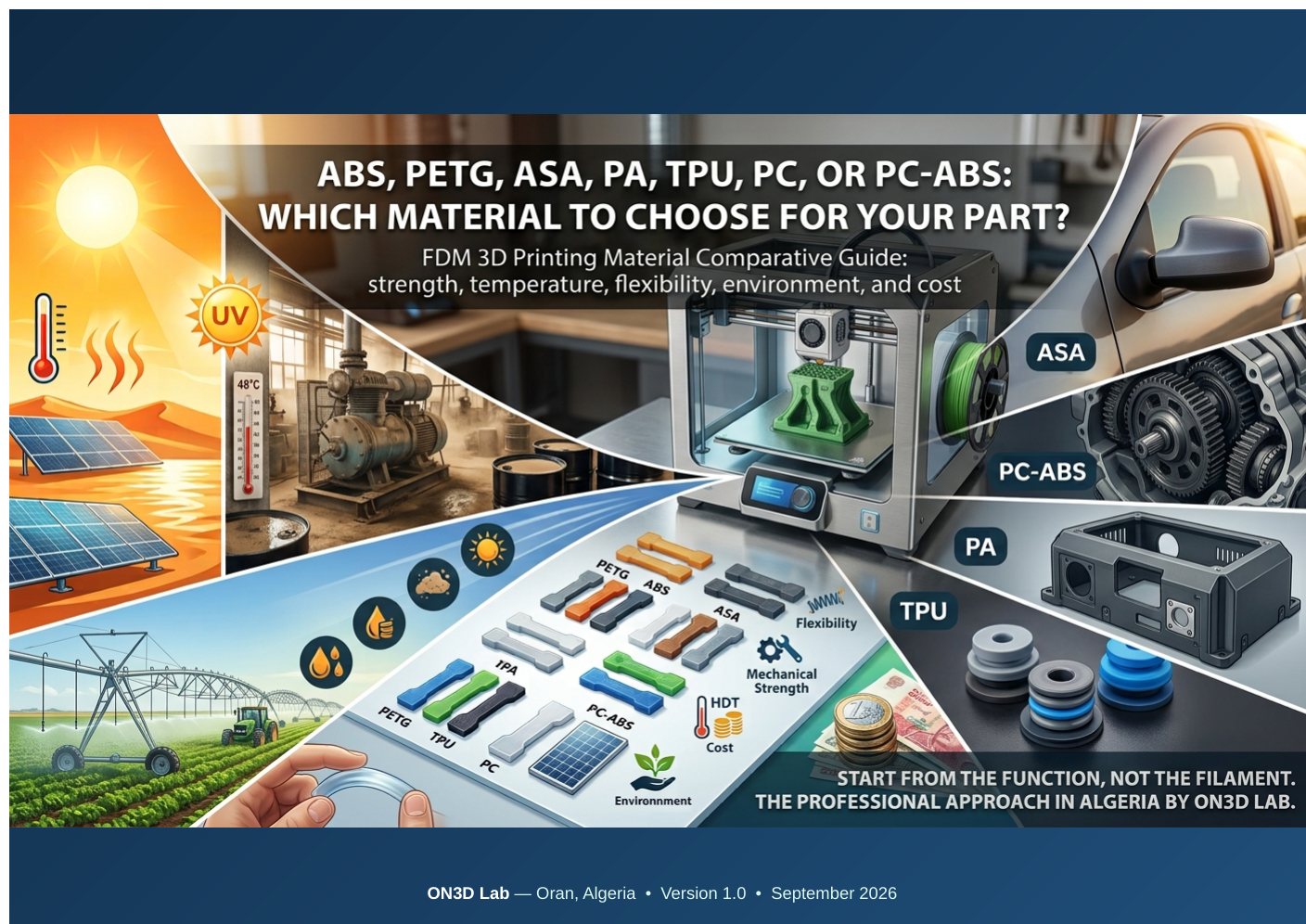
ABS, PETG, ASA, PA, TPU, PC or PC-ABS: Which material should you choose for your part?
A practical guide to selecting an FDM material for your part's actual exposure to heat, UV, impacts, friction, moisture and cost constraints.
When should an Algerian company choose FDM 3D printing or injection moulding for small plastic batches? Costs, quality, limitations and a decision method.
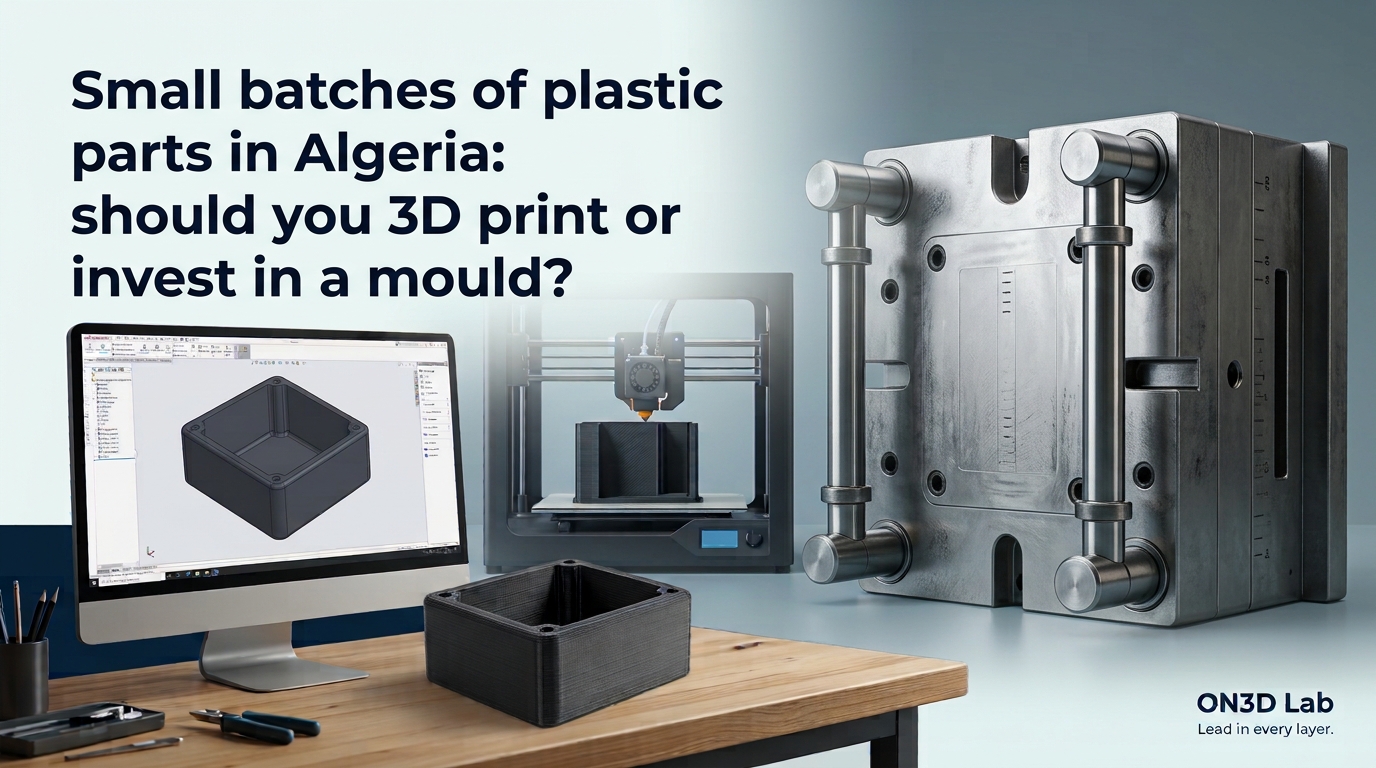
A plastic part may be easy to manufacture, but choosing the right production method requires more thought. Between 3D printing and injection moulding, the best solution depends as much on technical requirements, lead times and project maturity as on quantity.
Do you need to produce a few copies of a plastic part, launch a pre-production run or replace a specific component?
3D printing and injection moulding do not face the same economic constraints.
Before investing in a mould, consider volume, design stability, material, inspections and the actual delivery lead time.
For industrial companies in Algeria, this choice may also depend on raw material availability, local manufacturing capabilities and supply constraints.
Here is a method for comparing the two solutions without assuming that one technology is always better than the other.
A machine manufacturer, a maintenance workshop and a company developing a new product do not have the same needs.
The first may need a prototype to test an assembly. The second sometimes needs to replace a specific part that has become difficult to obtain. The third wants to verify its product before committing to regular production.
In these situations, three questions can guide the decision:
Has the design been finally validated? A product that may still change presents a financial risk when it requires a dedicated mould.
How many units will actually be needed? Consider not only the initial volume, but also future orders and the product’s commercial lifetime.
What would a delay or design change cost? A solution with a lower unit cost may become less attractive if it requires a high initial investment or slows development.
3D printing generally allows a more flexible start.
Plastic injection moulding often becomes attractive once the design is stable and volumes justify manufacturing the tooling.
The processes are therefore complementary, as Protolabs also explains in its comparative analyses. Cost comparison — Protolabs, Transition to injection moulding — Protolabs.
FDM/FFF 3D printing deposits a thermoplastic in successive layers.
The part is manufactured directly from its digital model, without a dedicated mould.
This method is particularly suited to prototypes, customised parts, tooling and certain limited production runs.
Injection moulding uses a mould into which molten polymer is injected.
Preparation involves tooling costs and specific design constraints, but manufacturing many identical parts can become particularly efficient.
| Criterion | FDM 3D printing | Plastic injection moulding |
|---|---|---|
| Initial investment | No dedicated mould | Mould design and manufacture |
| Design changes | Generally straightforward | May require modification of the mould |
| Unit cost | Depends on machine time, material and finishing | Generally lower at high volume |
| One-off production | Suitable | Often economically unattractive |
| Repeatability | Requires controlled parameters and inspections | High with a stable process |
| Geometric freedom | High, subject to manufacturability | Demoulding and design constraints |
| Main applications | Prototypes, pre-production runs, small batches | Regular production runs and high volumes |
These differences reflect general trends. Results depend on the geometry, material and requirements of the part. Process comparison — Protolabs, FDM — Protolabs.
This is probably the most frequently asked question.
Yet there is no universal quantity above which injection moulding consistently becomes less expensive.
The crossover point depends, in particular, on mould price, geometry, material, scrap rate and finishing operations.
To compare the processes, consider the total manufacturing cost.
3D printing:
Total cost = preparation and qualification + quantity × full cost per printed part.
Injection moulding:
Total cost = mould and process development + quantity × full cost per moulded part + specific logistics costs.
The calculation must include the actual costs of material, machine use, labour, inspection, energy and maintenance.
Delivery lead times and possible design changes must also be considered.
Formlabs published a comparison involving a small component manufactured by stereolithography (SLA) and injection moulding.
For 1,000 units, the company reports calculating approximately 600 dollars for SLA printing versus 3,920 dollars for injection moulding.
Under the specific conditions of its study, the break-even point was estimated at 13,050 parts.
These results illustrate the considerable influence of tooling costs.
However, they cannot be applied directly to FDM production at ON3D Lab, because the machines, consumables, geometry and economic assumptions differ. The 1,000-part study — Formlabs.
The most reliable method therefore remains a comparison of two quotations prepared against the same specification.
A successfully printed part is an initial result.
However, it does not automatically demonstrate that the part can be reproduced with sufficiently consistent characteristics.
Several steps must be followed to move from a prototype to a controlled small production run.
First, understand the function of the part.
Is it exposed to mechanical loads, vibration, friction, heat or chemicals?
Could a failure create a risk to people or equipment?
This information helps identify the essential technical requirements.
A first sample should allow the assembly, functional dimensions and actual use to be checked.
A part with an attractive finish is not necessarily functionally acceptable.
The properties of PETG, ABS, ASA, PA, PC or TPU vary with formulation and manufacturing conditions.
The choice must therefore reflect the operating environment and expected performance.
Reproducing a part requires control over, in particular, orientation, slicing parameters, material, drying conditions and any post-processing operations.
In FDM, layer orientation and adhesion influence mechanical properties.
A scientific review published in July 2025 confirms that the quality of interlayer bonds remains an important issue for part strength and anisotropy. Omer et al. — review of interlayer bonding in FDM.
Important dimensions and tolerances must be identified before manufacturing the batch.
A tolerance of 0.1 mm, for example, cannot be guaranteed indiscriminately across all geometries and materials without prior verification.
For each batch, it is useful to retain the part reference, revision, material used, manufacturing conditions and inspection results.
The ISO/ASTM 52901:2017 and ISO/ASTM 52920:2023 standards provide relevant references for ordering requirements and quality control in additive manufacturing.
However, drawing on these standards does not constitute certification. ISO/ASTM 52901:2017, ISO/ASTM 52920:2023.
Several sectors can benefit from producing plastic parts in small quantities.
A workshop may need a sensor bracket, spacer, non-critical cover or specific assembly accessory.
When quantities are low and the parts are technically compatible with the process, 3D printing can avoid investing in a mould.
Production lines use many positioning elements, guides, adapters and assembly accessories.
Certain parts can be designed and manufactured by 3D printing after their operating conditions have been validated.
However, these components must be distinguished from parts intended for direct food contact, which require specific material, health and regulatory checks.
A company wishing to market a new product can begin with a few functional prototypes.
After ergonomics and assembly have been validated, a small batch can allow its use to be tested.
Once the product is stable and volumes are confirmed, injection moulding can be considered.
This progression limits irreversible financial commitments before the product has been validated.
These examples describe potential applications and are not presented as work carried out by ON3D Lab.
For a company in Oran, Mostaganem, Tlemcen or another wilaya, the manufacturing choice cannot be based solely on the theoretical price of the process.
Raw material availability, supply lead times, transport costs and access to specialist service providers must also be considered.
A subcontracted mould may involve procedures and lead times that need to be incorporated into the schedule.
Conversely, local additive manufacturing still depends on suitable materials being available and on the workshop’s technical capabilities.
The choice can therefore change as the project progresses:
3D-printed prototype → functional validation → pre-production run → industrialisation using the most suitable process.
Injection moulding and additive manufacturing can also coexist: some part references are moulded in large quantities, while specific variants and components with low demand are produced on demand.
To obtain a reliable quotation, the customer should ideally provide a STEP file or a dimensioned drawing, along with a description of the part’s function.
It is also important to specify critical dimensions, operating conditions, the desired material or required performance, the initial quantity, forecast volumes and the expected delivery date.
This information enables the manufacturer to assess not only geometric feasibility, but also the actual operating constraints.
An incomplete specification can lead to a part that matches the digital file but is unsuited to its function.
3D printing should not be viewed solely as a repair or emergency solution.
It is also a relevant development and manufacturing method for certain plastic parts produced in limited quantities.
Injection moulding retains a significant advantage as volumes increase and specifications become stable.
The real objective is therefore not to print at any cost, but to choose the manufacturing method best suited to the industrial need.
At ON3D Lab in Oran, we support companies with the modelling, prototyping and additive manufacturing of technical plastic parts.
To assess the feasibility of a part or a pre-production run, a technical drawing, a 3D file and a description of the operating conditions provide a sound starting point.
ON3D Lab — on3d-lab.pro
A practical guide to selecting an FDM material for your part's actual exposure to heat, UV, impacts, friction, moisture and cost constraints.
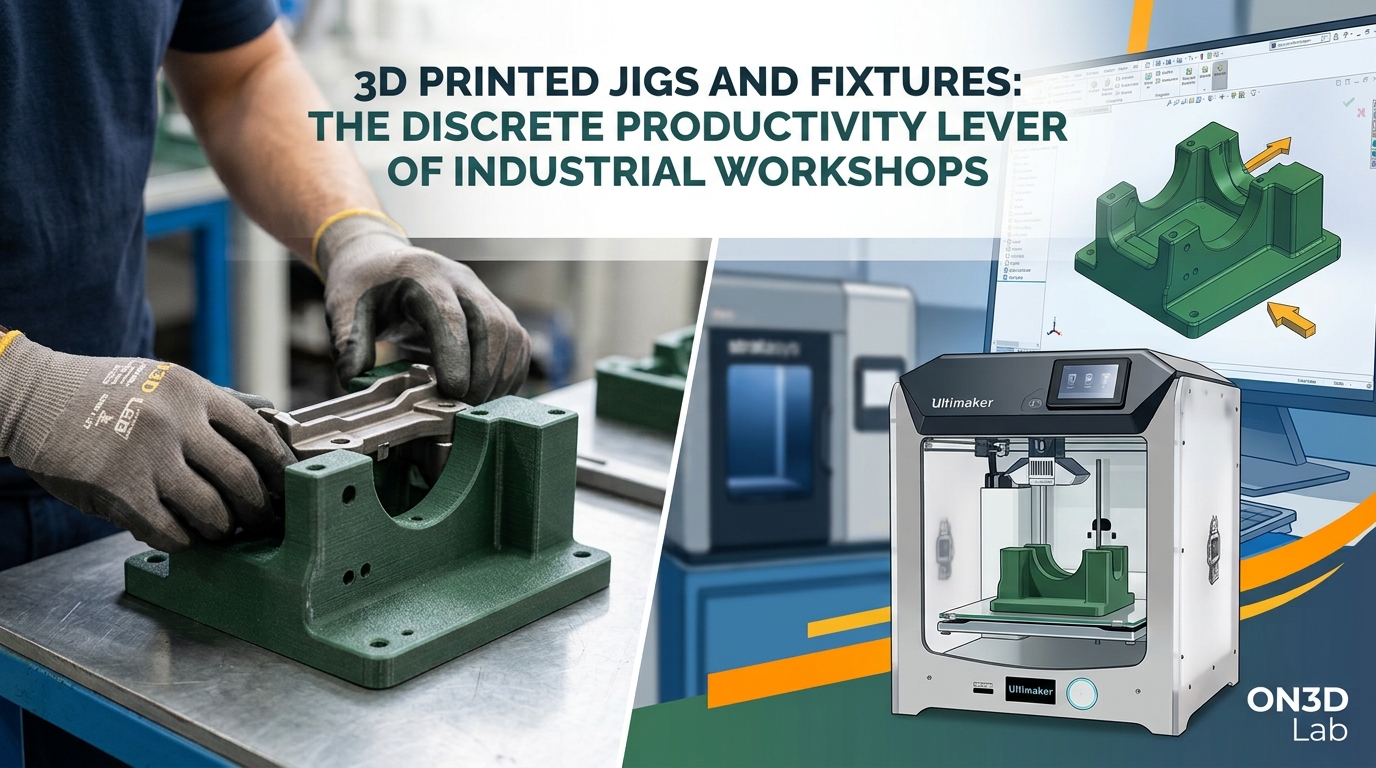
A well-designed plastic tool can make positioning, assembly and inspection easier. Explore applications, limitations and a practical method for assessing workshop benefits.
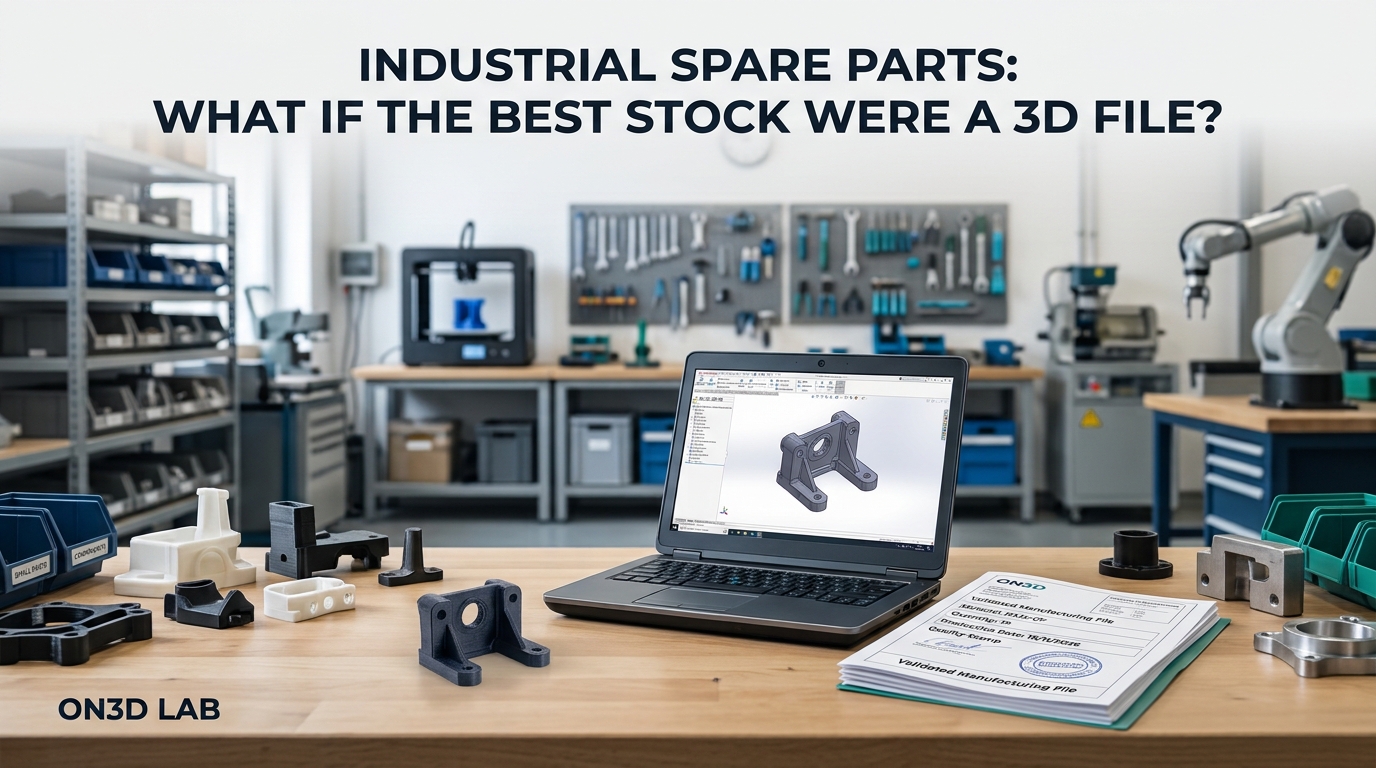
Some plastic parts are better retained as validated manufacturing dossiers than as dormant stock. Methods, examples and limitations.